
What is the political spectrum – right vs left wing
You’ll often hear people talk about right and left wing politics – but did you know that there’s not really just one defined version of it. People’s beliefs tend to fit somewhere on a spectrum between far left and far right wing.
Let’s take a look at the political spectrum and what values fit on the left and right side of it.
The political spectrum as a whole
The spectrum goes from the extreme far left all the way to the extreme far right. Some scholars think that it’s way too simplistic to describe political values but since right and left wing is really common in how we speak about politics in the UK I think it’s still worth looking at that to get to grips with what people mean when they talk about left and right wing.
So take this as a simple guide to these terms but know that people’s beliefs tend to be very complicated – they might believe in something but not to extremes, or only in certain circumstances
At the extreme far left of this spectrum you have radical communism and at the extreme far right you have fascism and Nazism – not many people are at the very extremes! We’re not talking about the extremes in this article (one for future) – we’re talking about general left wing, right wing and the centre where most people fit.
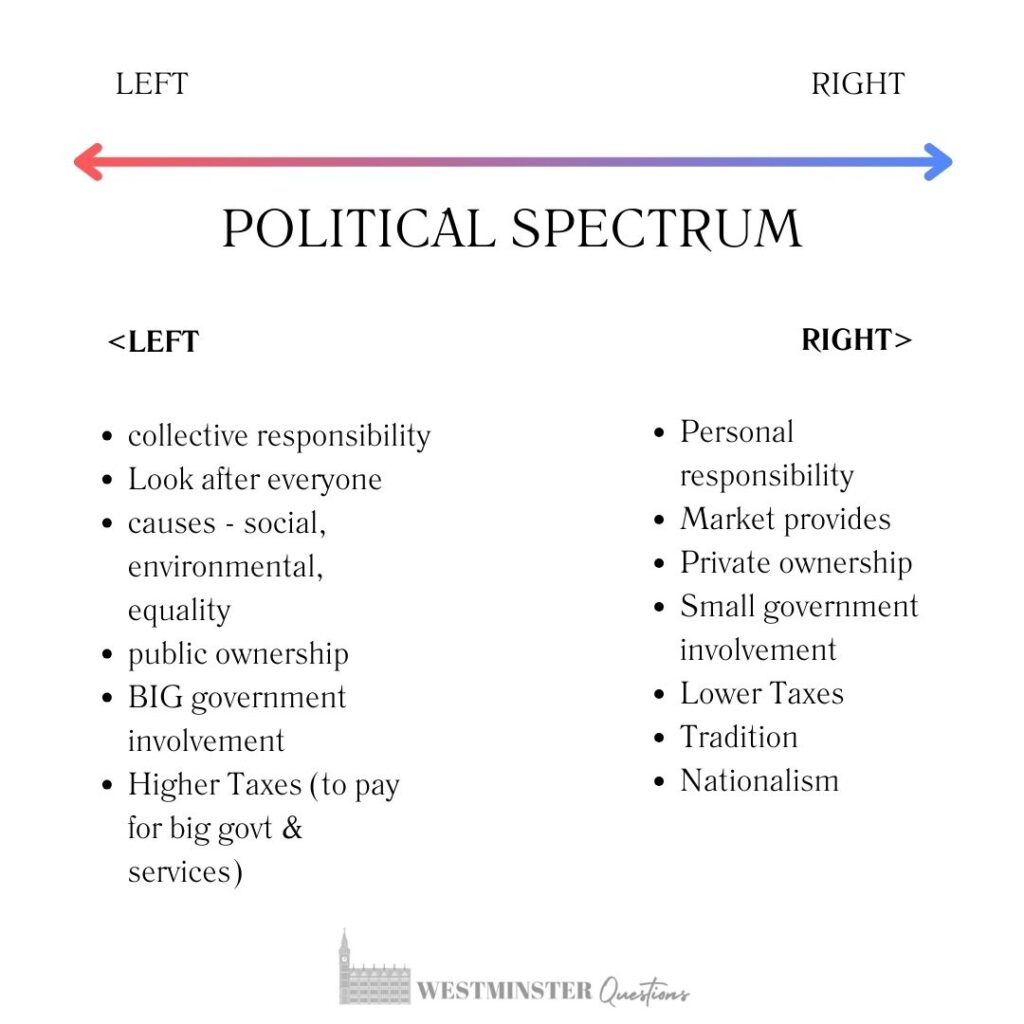
Left wing values & beliefs
On the left of the spectrum the values and beliefs that are held focus around something called collective responsibility. They believe that everyone should be looked after and there should be a safety net to catch vulnerable people.
They are often cited as progressive because a lot of the societal and environmental causes they champion will progress our society as a whole – think of workers rights or women’s rights and how the world changed with those being fought for.
They also believe in public ownership of some industries. Health, water, energy, transport and education are some examples of industry where they believe the government should be in charge. Depending on where you fit on the spectrum you might want a lot in public ownership or maybe just a small amount.
In order for everyone to be looked after there generally tends to be a larger government looking after the society and in turn this needs paid for so higher taxes are often a feature.
Right wing values & beliefs
On the other side of the spectrum the right wing believe in something called personal responsibility. They don’t think there should be a safety net and that without it everyone would strive to look out for themselves more.
They are more traditional – sometimes they approve hierarchal structures and the class distinctions. Often they can be fans of Royalty. In the extreme of the Right this can lead to feeling that some sections of society are superior to others.
Those on the right believe that a free market will provide for society and they feel that private companies are the best option for many industries such as health, energy, transport etc. The belief is that the need to make profits means that companies are more effective and less wasteful.
With less public ownership and a personal responsibility mindset the government isn’t needed as much – those on the right believe in liberty and a light touch from the government. And as such the Government shouldn’t need so much tax so the burden on the public is less.
Centrism – how does that fit in?
Centre politics comprise of very much middle of the road views, but also centre-left and centre-right thoughts.
People in the centre might lean one way but not to the extremes of the right and left wing views. They might also have a cross over.
Centrism is often cited as where the majority of the UK population lie and that’s perhaps why we swing from a left or centre left government in Labour to a right or centre right government in the Conservatives. People want a change but not that much of a change!
Conclusion
This is a very light overview of the political values on a left – right spectrum.
Does it help you see why some people might then say these things:
- that Labour ‘always want to raise taxes’ (maybe to provide for a bigger government)
- that Conservative ‘will get rid of our public services and the NHS’
- that far right political groups believe that UK citizens are superior than immigrants
- that left wing political groups essentially want a ‘nanny state’ (government looking after everyone)
It might also explain why:
- big media companies (such as newspapers) are often right wing – they might prefer less tax!
- entrepreneurs & businesses prefer a more right wing approach. Less regulation, tax and oversight by the government is helpful for growth
- individuals on lower wages might prefer a left wing approach – they might believe they are not be able to afford the services if they were all privatised. (Think of the US approach to healthcare and how many lower income sections of that society are unhealthy and don’t get sufficient healthcare)
- marginalised groups sometimes fit with a left wing ideology – they know that they will fight for their rights.
Of course, not all of this is always true. It’s very much a generalisation – but you can see why some people may have those beliefs and those narratives, especially about others.